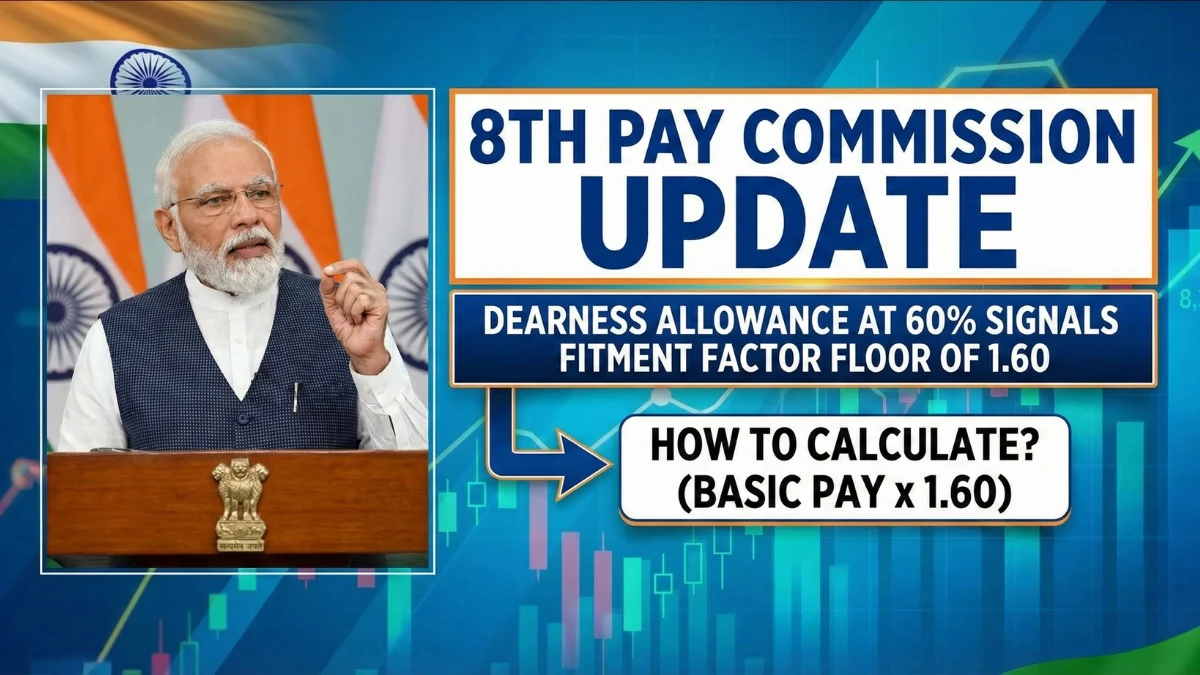
Discussion around the 8th Pay Commission has intensified after reports highlighted Dearness Allowance (DA) nearing the 60% level, prompting questions about whether this signals a fitment factor floor of 1.60. To avoid misinformation, it is important to clarify that no official pay commission notification has been issued yet. This article explains the current factual position, how DA levels are typically interpreted in pay revisions, and how fitment factor calculations are logically derived, based on past pay commission practices in India.
Is the 8th Pay Commission Officially Announced
As of now, the 8th Pay Commission has not been formally constituted. There is no cabinet approval, notification, or terms of reference released by the government. Any discussion around DA percentages or fitment factors is analytical, not official.
Why 60% Dearness Allowance Is Being Discussed
DA is calculated to offset inflation and is revised periodically. Historically, when DA approaches or crosses certain thresholds, discussions begin around salary restructuring. The 60% figure is being referenced because DA is often reset to zero when a new pay commission is implemented, with its value absorbed into the revised basic pay through the fitment factor.
How Fitment Factor Is Linked to DA
| Component | Explanation |
|---|---|
| Basic Pay | Existing salary before revision |
| Dearness Allowance | Inflation-linked component |
| Fitment Factor | Multiplier applied to revise pay |
| DA Reset | DA merged into basic pay |
| New Basic Pay | Revised salary post-merger |
Does 60% DA Automatically Mean 1.60 Fitment Factor
No. A 1.60 fitment factor is not automatic or guaranteed. While a simplified assumption suggests that if DA is merged fully, the minimum logical multiplier could start around 1.60, past pay commissions have applied higher fitment factors to ensure real salary growth beyond inflation adjustment.
How Fitment Factor Is Usually Calculated
Fitment factor calculations typically consider DA merger, pay compression correction, and real wage growth. For example, if the current basic pay is multiplied by a factor that absorbs DA and adds a margin, the final factor may be higher than the DA percentage alone.
Example Calculation (Indicative Only)
If an employee’s basic pay is ₹20,000 and DA is at 60%, the DA component equals ₹12,000. Merging DA brings the notional base to ₹32,000. Any additional increase recommended by the commission would raise the effective fitment factor beyond 1.60. This is illustrative only, not a confirmed formula.
What Employees Should Rely On
Only official announcements from the Ministry of Finance and the Department of Personnel and Training can confirm pay commission structures. Online calculations should be treated as estimates, not entitlements.
Key Facts
- 8th Pay Commission is not officially notified
- 60% DA does not guarantee a 1.60 fitment factor
- Fitment factor includes more than DA merger
- Actual figures depend on government approval
- All current numbers are analytical, not official
Conclusion
While a DA level near 60% provides a reference point for understanding salary restructuring logic, it does not confirm a fitment factor floor of 1.60. The final decision on fitment factor, salary revision, and implementation timeline will depend entirely on official government action once the 8th Pay Commission is formally constituted.
Disclaimer
This article is for informational purposes only and does not constitute financial or employment advice. Pay commission outcomes are subject to government approval and official notifications.